


Welcome!
My name is Evelyn Delgado, I currently live in Calgary, Alberta Canada after being a reluctant Edmontonian for 6 years. I am home!
Everything I do is heavily influenced by the Reggio Emilia learning method. I love it’s aesthetics, it’s simplicity, it’s focus on student-centered learning, it’s lessons about the natural world, it’s respect for material culture and it’s curiosity for light and shadows as teaching tools. I enjoy flashing lights, loud repetitive music and interactive art.
I have worked in children’s spaces for the duration of my career starting at an indoor playground when I was in High School – I was hooked! I went on to study psychology and art education and have been incredibly fortunate to have worked in some of Alberta’s most renowned children’s spaces both on the floor as an educator and also behind the scenes as a programmer, a curriculum developer, an exhibit designer, a prototype coordinator and a project manager. I enjoy working with preschool children and their families the most, the first five years of a million firsts are incredibly rewarding for me to witness.
My curiosity also extends to my art practice where I work primarily with time-based media including hand drawn animation, liquid light, music, dance, and puppetry.
Education
This collection of courses represents my journey through the Masters of Interdisciplinary studies in Education and Adult learning. My overarching learning outcomes included integrated learning which brought various disciplines together including learning psychology, sociology and a variety of learning methodologies including challenge-based, project based and social learning. I developed an understanding of the contemporary and historical issues surrounding adult educational practice including issues around justice and equality. I had two interweaving themes through my studies, first I began my MAIS journey wondering what role happiness and positive emotions play in learning. As I advanced through my MAIS studies, I zeroed in on the important role that emotions play in learning. The second research focus that I explored was about the relationship between democratic leadership and inclusive education. I used this research to reflect and articulate my leadership style by looking at my career up to this point and who I am as an educator. It also highlights my respect for workplace learning.
Educational Pedagogy
Throughout my MAIS studies I was able to gather and adopt a wealth of educational methodology. All of these have shaped who I am as an educator. As I have challenged myself to enter the world of corporate learning, the theories that I have gathered will help me in my future as a Learning and Development professional.
- Kolb’s Experiential Learning Cycle
- Mezirow’s Transformative Learning theory
- Bloom’s Taxonomy
- ADDIE model of Instructional Design
- SAM Skills Assessment Manager
- Action Mapping
- Gagne’s 9 Events
- Kirkpatrick’s 4 Levels of Training Evaluation
- Mayer’s Principles
MAIS 601 Making Sense of Theory in the Humanities and Social Sciences
Your content goes here. Edit or remove this text inline or in the module Content settings. You can also style every aspect of this content in the module Design settings and even apply custom CSS to this text in the module Advanced settings.
Your content goes here. Edit or remove this text inline or in the module Content settings. You can also style every aspect of this content in the module Design settings and even apply custom CSS to this text in the module Advanced settings.
Your content goes here. Edit or remove this text inline or in the module Content settings. You can also style every aspect of this content in the module Design settings and even apply custom CSS to this text in the module Advanced settings.
Your content goes here. Edit or remove this text inline or in the module Content settings. You can also style every aspect of this content in the module Design settings and even apply custom CSS to this text in the module Advanced settings.
MAIS 601 Making Sense of Theory in the Humanities and Social Sciences
Your content goes here. Edit or remove this text inline or in the module Content settings. You can also style every aspect of this content in the module Design settings and even apply custom CSS to this text in the module Advanced settings.
Your content goes here. Edit or remove this text inline or in the module Content settings. You can also style every aspect of this content in the module Design settings and even apply custom CSS to this text in the module Advanced settings.
Your content goes here. Edit or remove this text inline or in the module Content settings. You can also style every aspect of this content in the module Design settings and even apply custom CSS to this text in the module Advanced settings.
Your content goes here. Edit or remove this text inline or in the module Content settings. You can also style every aspect of this content in the module Design settings and even apply custom CSS to this text in the module Advanced settings.
MAIS 601 Making Sense of Theory in the Humanities and Social Sciences
Your content goes here. Edit or remove this text inline or in the module Content settings. You can also style every aspect of this content in the module Design settings and even apply custom CSS to this text in the module Advanced settings.
Your content goes here. Edit or remove this text inline or in the module Content settings. You can also style every aspect of this content in the module Design settings and even apply custom CSS to this text in the module Advanced settings.
Your content goes here. Edit or remove this text inline or in the module Content settings. You can also style every aspect of this content in the module Design settings and even apply custom CSS to this text in the module Advanced settings.
Your content goes here. Edit or remove this text inline or in the module Content settings. You can also style every aspect of this content in the module Design settings and even apply custom CSS to this text in the module Advanced settings.
MAIS 601 Making Sense of Theory in the Humanities and Social Sciences
Overview
- This course served as a preparation for graduate work in interdisciplinary studies, laying the groundwork for the application and development of theoretical perspectives in their various itineraries. It promoted dialogue on thinking, and writing in an interdisciplinary way. The course not only provided an opportunity to explore the origins and meanings of the various theories that inform the contemporary humanities and social sciences, but it initiated me as a learner into the role of the theoretician who frames the world in a certain way in order to render particular phenomena more salient for study and analysis.
Learning Outcomes
- Define what it means to “theorize,” explain its relevance to individual and social life, as well as identify relevant theories and apply them to contemporary issues/problems (MA-IS program outcome: social relevance),
- Critically discuss and describe what an “interdisciplinary theory” might look like (MA-IS program outcome: integrated learning)
- Demonstrate a critical understanding of some of the more influential theoretical models and schools across the disciplines of the humanities and social sciences, as well as discuss and critically evaluate the meaning of “decolonization” with respect to various theoretical approaches
Artefact
More Info
MAIS 601 Making Sense of Theory in the Humanities and Social Sciences
Overview
- This course served as a preparation for graduate work in interdisciplinary studies, laying the groundwork for the application and development of theoretical perspectives in their various itineraries. It promoted dialogue on thinking, and writing in an interdisciplinary way. The course not only provided an opportunity to explore the origins and meanings of the various theories that inform the contemporary humanities and social sciences, but it initiated me as a learner into the role of the theoretician who frames the world in a certain way in order to render particular phenomena more salient for study and analysis.
Learning Outcomes
- Define what it means to “theorize,” explain its relevance to individual and social life, as well as identify relevant theories and apply them to contemporary issues/problems (MA-IS program outcome: social relevance),
- Critically discuss and describe what an “interdisciplinary theory” might look like (MA-IS program outcome: integrated learning)
- Demonstrate a critical understanding of some of the more influential theoretical models and schools across the disciplines of the humanities and social sciences, as well as discuss and critically evaluate the meaning of “decolonization” with respect to various theoretical approaches
Artefact
More Info
MAIS 601 Making Sense of Theory in the Humanities and Social Sciences
Overview
- This course served as a preparation for graduate work in interdisciplinary studies, laying the groundwork for the application and development of theoretical perspectives in their various itineraries. It promoted dialogue on thinking, and writing in an interdisciplinary way. The course not only provided an opportunity to explore the origins and meanings of the various theories that inform the contemporary humanities and social sciences, but it initiated me as a learner into the role of the theoretician who frames the world in a certain way in order to render particular phenomena more salient for study and analysis.
Learning Outcomes
- Define what it means to “theorize,” explain its relevance to individual and social life, as well as identify relevant theories and apply them to contemporary issues/problems (MA-IS program outcome: social relevance),
- Critically discuss and describe what an “interdisciplinary theory” might look like (MA-IS program outcome: integrated learning)
- Demonstrate a critical understanding of some of the more influential theoretical models and schools across the disciplines of the humanities and social sciences, as well as discuss and critically evaluate the meaning of “decolonization” with respect to various theoretical approaches
Artefact
More Info
MAIS 601 Making Sense of Theory in the Humanities and Social Sciences
Overview
jfjfkkfjkdjfkll;ll;
Artefact More Info
MAIS 601 Making Sense of Theory in the Humanities and Social Sciences
Overview
jfjfkkfjkdjfkll;ll;
Artefact More Info
Education Background
Summary
My undergraduate degree in Fine Arts – Art Education from Concordia University focused on the unique relationship between research, creation, and pedagogy. I received solid training in artistic and teaching practices. This is the only school in Canada that offers a BFA in community-based Art Education. With this degree I was able to have a very fulfilling career in exhibit design, planning and curriculum development, and interpretation in community spaces including children’s museums, science centers, galleries, and museums. It helped me fulfill my lifelong goal of using art education as a tool for community development and social change.
I also received a minor in psychology which I gathered while attending University of Calgary and Mount Royal College. This part of my degree asked about child development, educational psychology which helped me develop an understanding about the function of the brain in learning. I was able to gain experience in thinking critically and solving problems, conducting research, analyzing data and communicating effectively. Lastly, I developed skills in information literacy, implementing ethical principles and applying psychological knowledge and skills to personal, social, organizational, and societal problems.
Learning Outcomes
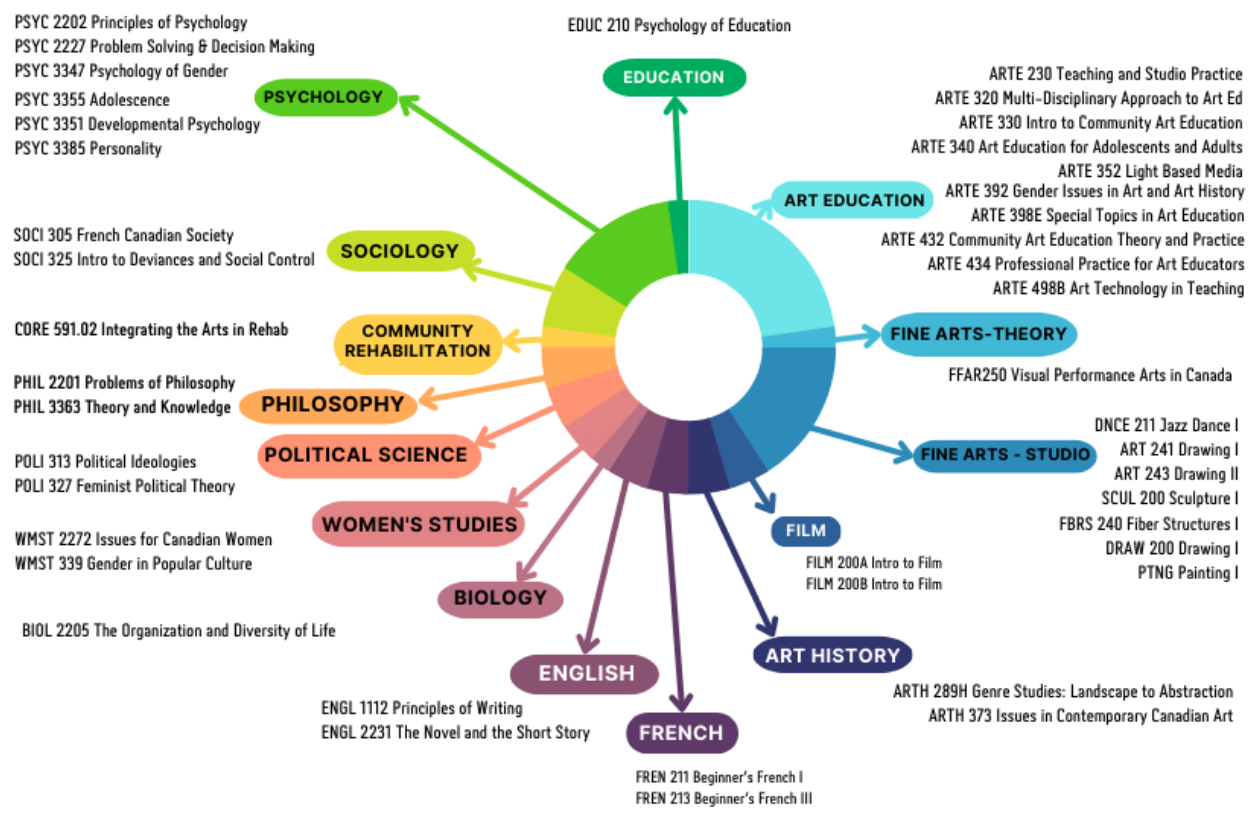
Education
This collection of courses represents my journey through the Masters of Interdisciplinary studies in Education and Adult learning. My overarching learning outcomes included integrated learning which brought various disciplines together including learning psychology, sociology and a variety of learning methodologies including challenge-based, project based and social learning. I developed an understanding of the contemporary and historical issues surrounding adult educational practice including issues around justice and equality. I had two interweaving themes through my studies, first I began my MAIS journey wondering what role happiness and positive emotions play in learning. As I advanced through my MAIS studies, I zeroed in on the important role that emotions play in learning. The second research focus that I explored was about the relationship between democratic leadership and inclusive education. I used this research to reflect and articulate my leadership style by looking at my career up to this point and who I am as an educator. It also highlights my respect for workplace learning.
Continuing Education Courses
- AIP2 Planning and Techniques
- Disney University: Quality Service
- High Five
- Ideo’s Design Thinking
MAIS Courses
- MAIS 601- Making Sense of Theory in the Humanities
- MAIS 642 – Program Planning, Evaluation, and Instructional Methods in Adult Education
Artefacts
Artefacts Summary
The following artifacts were chosens to showcase my academic journey throughout my MAIS studies. Including how I achieved my academic goals of integrating multidisciplinary and interdisciplinary approaches to a variety of different disciplines, applying critical thought throughout, participating in academic teamwork and creating social awareness through my research.
I begin with “Critical Reflection Essay: Sonic Warfare and the Politics of Sensation” Which i wrote for MAIS 601 during my first semester. I chose this paper because it highlights a turning point in my understanding of what it means to be a student. Adult Education practice focuses on self directed learning. I had invested interest in this topic and its articulation helped me to understand where I can excel as a student. It also taught me how important the connection between student and subject matter is to the success of the student.
The second artifact I chose was my final project for MAIS 642: Final Project: Adult Learning Project: Happiness for Retirees. This project highlights my skills as an Adult Learning professional. I had been working as a program developer for many years and it was a nice exercise to revisit the planning process, breaking each step one by one. I enjoy the theme of this project, but I overplanned. Now that I have the chance to reflect on my work I see where I can improve. The content of the class, playfulness and happiness, are concepts which were reviewed throughout my MAIS journey. These are important socially relevant topics and their interrogation can benefit countless people.
Next was my final project in MAIS 602: Play and Playfulness Pedagogy in Museum learning spaces for Adult Audiences. This paper looked at the role of play as a tool for engaging adults in museum settings. The purpose of this project was to justify the methodologies I intend to use in my research and the ethical challenges I may encounter and how I would hope to mitigate them. Interrogating the research process, and addressing a variety of methodology was an important exercise which I continued to revisit throughout my MAIS journey. I revisited the topic of play pedagogy once again, finding new sources of intrigue.
The fourth artifact is my final research paper for INST 511, Using Indigenous Picture books to Connect ot Indigenous Ways of Knowing. I used my background in child development, early literacy and early learning to approach difficult and challenging topics. I chose this artifact because I believe that the content of the paper would have benefited from a different presentation.
Next is my final paper for MDDE 601, Literature review of corporate e-Learning. I chose this artifact because it highlighted an important turning point in my academic studies and also in my professional career. This project helped me understand the integration of workplace e-learning including evaluation, which is one of the most important facets of programming. This project also helped me to realize how confident I was becoming as a student.
The sixth artifact is an argument paper that I wrote for MDDE 631, Democratic Leadership as the Foundation for Inclusive Education. I interrogated my leadership style throughout my MAIS journey including MAIS 642, MAIS 644, EDST 646 and MDDE 631. I chose this artifact because not only does it demonstrate my in depth analysis of Democratic leadership style, but it also demonstrates very strongly how this leadership style applies to me. I then show how I can use this leadership style to approach inclusive learning practices. This is a major revelation for me as an Educator and the skills and knowledge that I articulated in this paper will serve me throughout my career.
The seventh and last artefact is the final paper for EDST 645, Expression and Embodiment of Emotions in Learning. This paper allowed me to bring together knowledge from psychology, neuroscience and education. I was able to address and explore the complex role that emotions play in learning, especially workplace learning. When I began my studies I had looked at play and playfulness and their role in learning, but by the end of my studies I realized that all emotions are valid and their role in workplace learning is a complex one.

Artefact 2
Your content goes here. Edit or remove this text inline or in the module Content settings. You can also style every aspect of this content in the module Design settings and even apply custom CSS to this text in the module Advanced settings.
Your Title Goes Here
Your content goes here. Edit or remove this text inline or in the module Content settings. You can also style every aspect of this content in the module Design settings and even apply custom CSS to this text in the module Advanced settings.
Artefact 3
Your content goes here. Edit or remove this text inline or in the module Content settings. You can also style every aspect of this content in the module Design settings and even apply custom CSS to this text in the module Advanced settings.
Artefact Test (PDF)
Your content goes here. Edit or remove this text inline or in the module Content settings. You can also style every aspect of this content in the module Design settings and even apply custom CSS to this text in the module Advanced settings.
Read Summary >> Read Content >>
Your Title Goes Here
Your content goes here. Edit or remove this text inline or in the module Content settings. You can also style every aspect of this content in the module Design settings and even apply custom CSS to this text in the module Advanced settings.
Focus Area Reflection: Adult Education
I have become more and more interested in the dissemination of information – the game of telephone that happens when an instructor presents information and those students present a digested form of the same information to their students. I noticed my interest in adult learning while training new staff on the gallery floor of the alternative learning institutions I worked in…
…To read more click below
Read here the complete content:
Focus Area Reflection: Adult Education
I have become more and more interested in the dissemination of information – the game of telephone that happens when an instructor presents information and those students present a digested form of the same information to their students. I noticed my interest in adult learning while training new staff on the gallery floor of the alternative learning institutions I worked in. I enjoy the Reggio Emilia concept of the “three teachers” in a child’s life (first the parents, second the teachers and third the space in which learning occurs). I feel rewarded when I help educators make sense of the third teacher. I enjoy using provocation techniques to get educators to learn more about their teaching methods and enhance their own classroom experience. For the first half of my life (reluctantly admitting to myself that I have officially reached middle age), I worked with young children in children’s spaces, but as I gained more experience and more of an understanding of the best practices and pedagogy, I found myself teaching other educators. I want to get better at providing information to adults, I can’t rely on making songs about the concepts we are learning, not all the time.
The covid-19 pandemic seriously disturbed my industry. I focused on interactive hands-on learning and that has not been possible for the past 3 years. The covid pandemic also caused significant change in my personality, the fear of being sick has challenged me. I have always been apprehensive about germs but it was manageable as I had learned healthy coping mechanisms, but those no longer work. I am not sure why adult education is what I chose, I am learning a lot of things that I do find relevant, particularly the notion that adult programmers are primarily negotiators. That fact has been life changing.
The MAIS 601 readings that are relevant to my focus area of adult education are those that dealt with approaching a subject matter from multiple angles and all imaginable perspectives. In the article about reimagining soils (Puig de la Bellacasa, 2019), due to advancements in technology, our view of soil has changed, both metaphorically and physically. We are better able to see soil as a living entity. If we change our perspective of soil from an inanimate object to an animated one, we strengthen our relationship, and relate to it with human-soil affections. This reframing of thought is an important lesson to bring to an adult education class. Included in that lesson is the human connection to a subject matter, the power of emotions to cause adults to care is also important. We revised this concept in the article about the interplay of human and nonhuman realities (Ionescu, A. 2021), there we looked at children’s literature for broader lessons about our own humanity. The stories reframed our understanding of ourselves as people. It used emotional connections for objects around us to reframe what we know about ourselves. These lessons are important in adult education because of the motivational factors that adult learners need. These lessons were particularly important for me and my work with objects, materials, tools and hands-on learning. I have known that presenting a subject from multiple perspectives is important, it is also important to let students figure out for themselves what those multiple perspectives may be and follow their lead. But there is also a lesson here about the subject matter itself, at the beginning of my MAIS journey I had not explored the subject of adult learning from all perspectives. I saw it (and still somewhat see it) as a one way path to corporate education, but I am beginning to appreciate my experience in ways that I hadn’t thought of at the beginning of this journey. My own history is alive with possibilities.
What is the difference between education for adults and adult education? Adult education can be found in human resource training, workplace learning, and professional development. It can be formal, non-formal and informal. Since its inception, adult education had been known as a movement, but now it is more recognized as a process. A process that can support other social movements. Adult education needs to draw from the experience that each learner brings – this is always true in a learning setting, but adults have accumulated a significant amount of life experience that needs to be acknowledged.
Adult education combines theories from a variety of different disciplines. It has foundations in sociology through the work of Emile Durkeheim and his theory on structural functionalism, the work of Mark Weber and his theory on symbolic interactionism and through the work of Karl Marx, who was concerned with “determining the causes of inequality and injustice in a variety of economies” (Woelke, 2017). There are many grassroots organizations throughout Canada’s history. The need for people to be educated and come together to learn for the betterment of society is admirable. However many of these educational organizations and movements began with racist and colonialist roots. It made me wonder about ethics and how companies evolve from their dark past, do they acknowledge it? Make reparations? How invested in the historical ethics of a company will I need to be?
The article on the role of adult education (Woelke, L, 2017) talked about how there are adults who may find themselves overwhelmed in adult education spaces, bringing with them negative experiences from formal school settings. I feel that there will be a need to reframe an adult’s perspective to not be one that is concerned with attending a classroom, and or interacting with a teacher, but instead to reframe their understanding of education to be that of interacting with knowledge.
Ionescu, A. (2021) The Interplay of Human and Nonhuman Realities in Shaun Tan’s Tales from Outer Suburbia. Configurations 29(3) 267-287
Puig de la Bellacasa, M. (2019) Re-imagining soils: Transforming human-soil affections through science, culture and community. The Sociological Review Monographs, 67(2), 391-407
Woelke, L. (2017, June 6). The role of adult education [Presentation for The University of the Fraser Valley]. Reproduced with permission from the author.
Reflective Analysis on The Interplay of Human and Nunhuman Realities in Shaun Tan’s Tales from Outer Suburbia (Ionescu, A. 2010)
I chose to do my reflective analysis on this article because I feel comfortable relating to the concept of objects due to my work in museums, and my time in early childhood learning spaces. My work in museums introduced me to the cultural importance of collecting, and my work with the Reggio Emilia method has led me to an appreciation of material culture both highlighting the importance of aesthetics and presenting the objects in ways that showcase their importance and elevate their significance. …
…To read more click below
Read here the complete content:
Reflective Analysis on The Interplay of Human and Nunhuman Realities in Shaun Tan’s Tales from Outer Suburbia (Ionescu, A. 2010)
I chose to do my reflective analysis on this article because I feel comfortable relating to the concept of objects due to my work in museums, and my time in early childhood learning spaces. My work in museums introduced me to the cultural importance of collecting, and my work with the Reggio Emilia method has led me to an appreciation of material culture both highlighting the importance of aesthetics and presenting the objects in ways that showcase their importance and elevate their significance. For the rest of the articles we have looked at thus far, my knowledge has been fairly limited, but with this article I am better able to analyze its content and it’s purpose. I was excited to begin my analysis, but I hit my first roadblock: Where is it? I read these articles yesterday, and closed my computer, now I am completely lost – Where are they? They are not in “communication” they are not in “resources”, not in the “audio lectures” I remember it was a downloadable google doc. BUT WHERE?!?!?! After an hour, I found it in the “discussion” section. My nerves and my feelings of defeat led me to an uncontrollable giggle fit the next 45 minutes -recalling what we had learned about how Derrida and other derridians gather information from many different places. Their discombobulated method of presenting information is a reflection of the message itself – information needs to be gathered and disseminated and understood under different contexts. This was particularly funny, as I just moved – I am exhausted from reorganizing my own life in a new city and my new apartment, tired of looking for the things I need when I need them. I am having the same struggles with this website and I am wondering if this is a lesson, most of the articles we have looked at in class have been long winded and (thorough? maybe thorough). We discussed how Derrida and derridians slowly meander through a topic. I see the website for this class is much the same and that lesson has made me laugh.
Back to the article, I am tempted to write about the similarities between the lessons in the article about post humanist my own struggles beginning with the lessons on interspecies empathy (the Academics: my professor and my classmates, and the non academic: Me.) particularly the description of one species having an “(in)capasity for language”. I feel so distant from my classmates that we might as well be different species! The points in this seccion expand to focus on animals and this point no longer applies..
The next lesson in the article was about objects having “thing-power” – this was the most relevant for me and the work that I do. I enjoyed the connections between the mundaneness of the everyday objects, their juxtaposition with the elements and illustrations in the book and their message about our world and our human need to connect to objects, or “non human elements”. The revelation that someone out there is studying material culture and children’s literature in this fashion (its connection to posthumanism) is making me want to explode with joy. My undergrad began in psychology, educational psychology and finally fine arts and art education. I was never able to study the theory of children’s literature, it just did not come up. What a revelation! Prior to reading this article I thought I knew a lot about our human connection to objects, but this is an entry point that I had yet to discover! When I started MAIS I was sure I would walk out with a briefcase in hand and march my way to a corporate office to do institutional learning. Maybe there is more in my future and I don’t have to end one chapter to start a completely different one.
Ionescu, A. (2021) The Interplay of Human and Nonhuman Realities in Shaun Tan’s Tales from Outer Suburbia. Configurations 29(3) 267-287
Focus Area Reflection: Adult Education
I have become more and more interested in the dissemination of information - the game of telephone that happens when an instructor presents information and those students present a digested form of the same information to their students. I noticed my interest in adult...
Reflective Analysis on The Interplay of Human and Nunhuman Realities in Shaun Tan’s Tales from Outer Suburbia (Ionescu, A. 2010)
Reflective Analysis on The Interplay of Human and Nunhuman Realities in Shaun Tan’s Tales from Outer Suburbia (Ionescu, A. 2010) I chose to do my reflective analysis on this article because I feel comfortable relating to the concept of objects due to my work in...
Focus Area Reflection: Adult Education
I have become more and more interested in the dissemination of information – the game of telephone that happens when an instructor presents information and those students present a digested form of the same information to their students. I noticed my interest in adult learning while training new staff on the gallery floor of the alternative learning institutions I worked in…
…To read more click below
I have become more and more interested in the dissemination of information – the game of telephone that happens when an instructor presents information and those students present a digested form of the same information to their students. I noticed my interest in adult learning while training new staff on the gallery floor of the alternative learning institutions I worked in…
Reflective Analysis on The Interplay of Human and Nunhuman Realities in Shaun Tan’s Tales from Outer Suburbia (Ionescu, A. 2010)
I chose to do my reflective analysis on this article because I feel comfortable relating to the concept of objects due to my work in museums, and my time in early childhood learning spaces. My work in museums introduced me to the cultural importance of collecting, and my work with the Reggio Emilia method has led me to an appreciation of material culture both highlighting the importance of aesthetics and presenting the objects in ways that showcase their importance and elevate their significance. …
…To read more click below
I chose to do my reflective analysis on this article because I feel comfortable relating to the concept of objects due to my work in museums, and my time in early childhood learning spaces. My work in museums introduced me to the cultural importance of collecting, and my work with the Reggio Emilia method has led me to an appreciation of material culture both highlighting the importance of aesthetics and presenting the objects in ways that showcase their importance and elevate their significance. …
Focus Area Reflection: Adult Education
I have become more and more interested in the dissemination of information - the game of telephone that happens when an instructor presents information and those students present a digested form of the same information to their students. I noticed my interest in adult...
Reflective Analysis on The Interplay of Human and Nunhuman Realities in Shaun Tan’s Tales from Outer Suburbia (Ionescu, A. 2010)
Reflective Analysis on The Interplay of Human and Nunhuman Realities in Shaun Tan’s Tales from Outer Suburbia (Ionescu, A. 2010) I chose to do my reflective analysis on this article because I feel comfortable relating to the concept of objects due to my work in...